Associated with
- Bowel bypass surgery, post surgical bowel blind loop, gastric resection, IBD, diverticulitis, PUD
- Bacterial overgrowth has been implicated
- May occur 1-6 years post surgically
Mecanismo: type III hypersensitivity → pustulose vasculítica
- Bowel bacterial overproliferation in a blind loop → causing complement activation and immune complex deposition in the skin
- Crops of red and purpuric papulo-vesicles in proximal extremities and truck
- Fever
- Arthritis
Clinical presentation
- 1-6 years after responsible bowel surgery
- Systemic
- ~serum sickness: fever, malaise, arthralgias, myalgias
- precede skin
- Persistent diarrhea
- → electrolyte imbalances
- → volume depletion → decreased renal uric acid excretion → hyperuricemia
- Bacterial overgrowth
- → deconjugation of bile salts
- Loss of bile salts & impaired synthesis of new bile salts → cholesterol supersaturation of bile → Gallstones
- → fat malabsorption
- → unabsorbed fatty acids bind luminal calcium → less calcium to bind oxalate → enteric hyperoxaluria
- → Renal calculi of oxalate calcium
- → Decreased lipid vitamin absorption (including vitamin A, K, E, D)
- Zinc absorption is bile dependent and bacteria compete for trace elements → Zinc deficiency
- → Ammonia production by bacteria
- → neurotoxicity → Emotional disturbances
- → Hepatic dysfunction
- Skin
- Erythematous macules which progress to papules and purpuric vesicopustules within 48 hours and last for 2-4 weeks
- May recur at 4-6 week intervals
- Favor proximal extremities and trunk
- Erythematous subcutaneous nodules due to nodular, non-suppurative lobular neutrophilic panniculitis or erythema nodosum
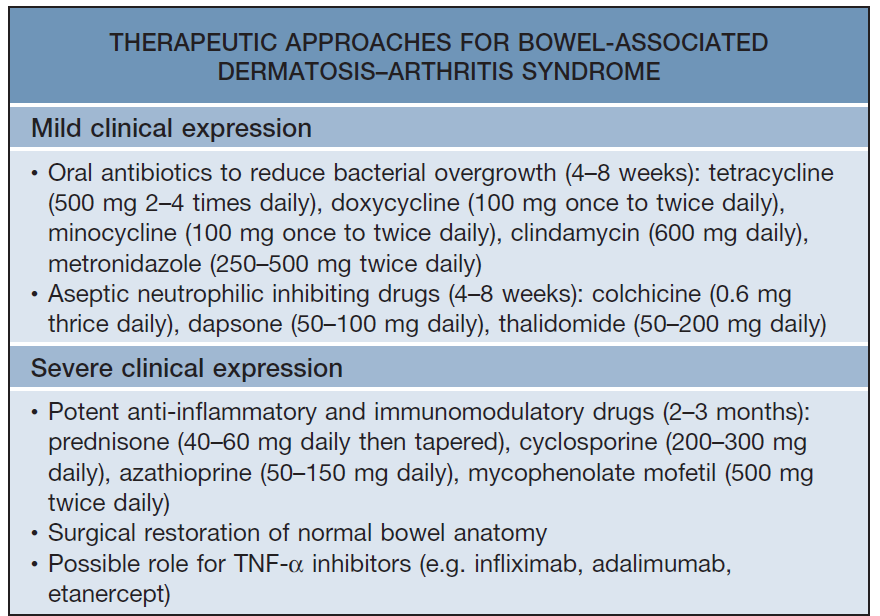
Treatment
- Antibiotic therapy → treats bacterial overproliferation
- Reverse blind loop
 Made with Bullet